1. Supply Quotas and the HFC Phase-Down
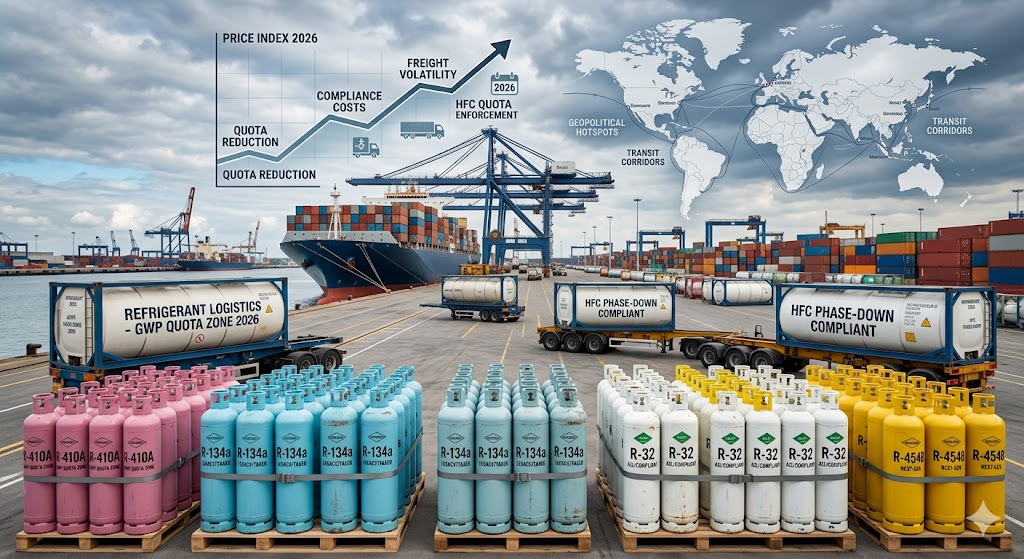
The primary catalyst behind wholesale refrigerant price volatility is the aggressive tightening of production and import quotas. Under international frameworks like the Montreal Protocol’s Kigali Amendment and domestic laws such as the U.S. AIM Act, the global supply of high-Global Warming Potential (GWP) hydrofluorocarbons (HFCs) is facing steep mandated reductions.
Because supply is legally restricted while an enormous global base of legacy equipment still requires servicing, the market frequently experiences sudden supply-demand imbalances. This artificial tightening of the supply structure acts as the structural foundation for long-term price increases. Furthermore, as of January 2026, regulatory milestones like the full enforcement of low-GWP mandates for new equipment have heavily altered buyer behavior, altering the market valuation of older gases relative to newer alternatives.
2. Regulatory Taxes and Compliance Costs
Beyond strict volume restrictions, the direct financial burden of regulatory compliance has risen significantly. A prime example of this trend is the implementation of specialized quota taxes in major markets. For instance, a carbon-equivalent quota tax introduces a per-tonne charge that directly inflates the base cost of high-GWP refrigerants like R134a.
These regulatory charges ripple straight through the wholesale supply chain, forcing manufacturers and major distributors to implement price corrections to preserve operational margins. Additionally, the rigorous testing, tracking, and certification protocols required to transport and trade hazardous pressurized gases add layered administrative costs that further elevate wholesale invoices.
3. Macroeconomic Factors and Manufacturing Inputs
Refrigerant gas production does not exist in a vacuum; it is deeply tied to broader macroeconomic shifts and raw material markets. The HVAC manufacturing sector faces intense cost pressures from fluctuating raw material prices, most notably copper, aluminum, and foundational chemical components.
| Manufacturing & Logistics Pressure Point | Impact on Wholesale Sourcing Costs |
| Volatile Base Metals | Surges in copper and aluminum directly raise the cost of system hardware and packaging cylinders. |
| Component Tariffs | Import duties on chemical compounds and steel cylinders add severe structural surcharges. |
| General Inflation | Ongoing labor, energy, and localized manufacturing overheads keep baseline floor prices elevated. |
4. Geopolitical Crises and Logistics Volatility
Global transport corridors remain highly vulnerable to geopolitical instability, which introduces a layer of unpredictability to landed wholesale costs. Major maritime disruptions—such as localized conflicts or trade route closures in key transit corridors—force freight vessels to take longer, more expensive alternative routes.
The resulting shipping bottlenecks heavily penalize the chemical transport sector. This friction has pushed air and ocean freight rates up significantly on major international trade routes. For wholesale buyers, these logistical challenges manifest as longer lead times, localized inventory shortages, and steep freight surcharges added to bulk cylinder orders.
5. Technology Transitions and Market Fragmentation
The ongoing technological pivot toward next-generation refrigerants creates a fragmented pricing landscape. As the industry fully shifts its focus toward lower-GWP alternatives, such as the mildly flammable A2L gases R32 and R454B, the production lines for legacy gases are scaling down.
This creates a dual-market dynamic:
- Next-Gen Compounds: Next-generation molecules often experience “boom-bust” price swings as production capacity scales up to meet sudden regional equipment mandates.
- Legacy Compounds: Older gases benefit from highly optimized, cost-effective manufacturing footprints, making them inherently cheaper to produce initially. However, their available quotas are diminishing so rapidly that their spot-market prices spike dramatically during peak summer demand cycles.